
Launching a startup is thrilling — but equally daunting. One of the most important tasks you’ll tackle is building awareness, acquiring customers, and scaling credibly. With limited resources and big ambition, the right digital marketing strategy can be your secret weapon.
In this blog, we’ll explore how startups can use digital marketing effectively: what to focus on, how to prioritise, what channels to pick, how to measure, and how to avoid common pitfalls. We’ll also pull in useful data and frameworks to give you a step-to-step roadmap.
Why Digital Marketing Matters for Startups
Digital marketing is essential for early-stage businesses, not just a “nice to have.”. Here’s why:
- It levels the playing field. Even with limited budgets, you can reach a global or local audience via online channels. One source puts this starkly: “Digital marketing gives you a 360-degree view … at a fraction of traditional marketing costs.” Salesforce+1
- Speed matters. Startups often need traction quickly. Digital channels allow you to test, iterate and adjust in real time. As one guide says: “Start by defining your target audience … experiment with organic and paid channels … track performance … then scale.” Helpware
- Data and measurement are built in. Unlike many traditional channels, you can measure what works, what doesn’t, and optimise accordingly. reliablesoft.net+1
- Brand building and credibility. A strong online presence helps you appear professional, credible and trustworthy — key when you’re new. reliablesoft.net+1
In short: if you’re a startup and aren’t thinking about digital marketing early, you’re risking falling behind.
Define Your Strategy — Audience, Positioning & Goals
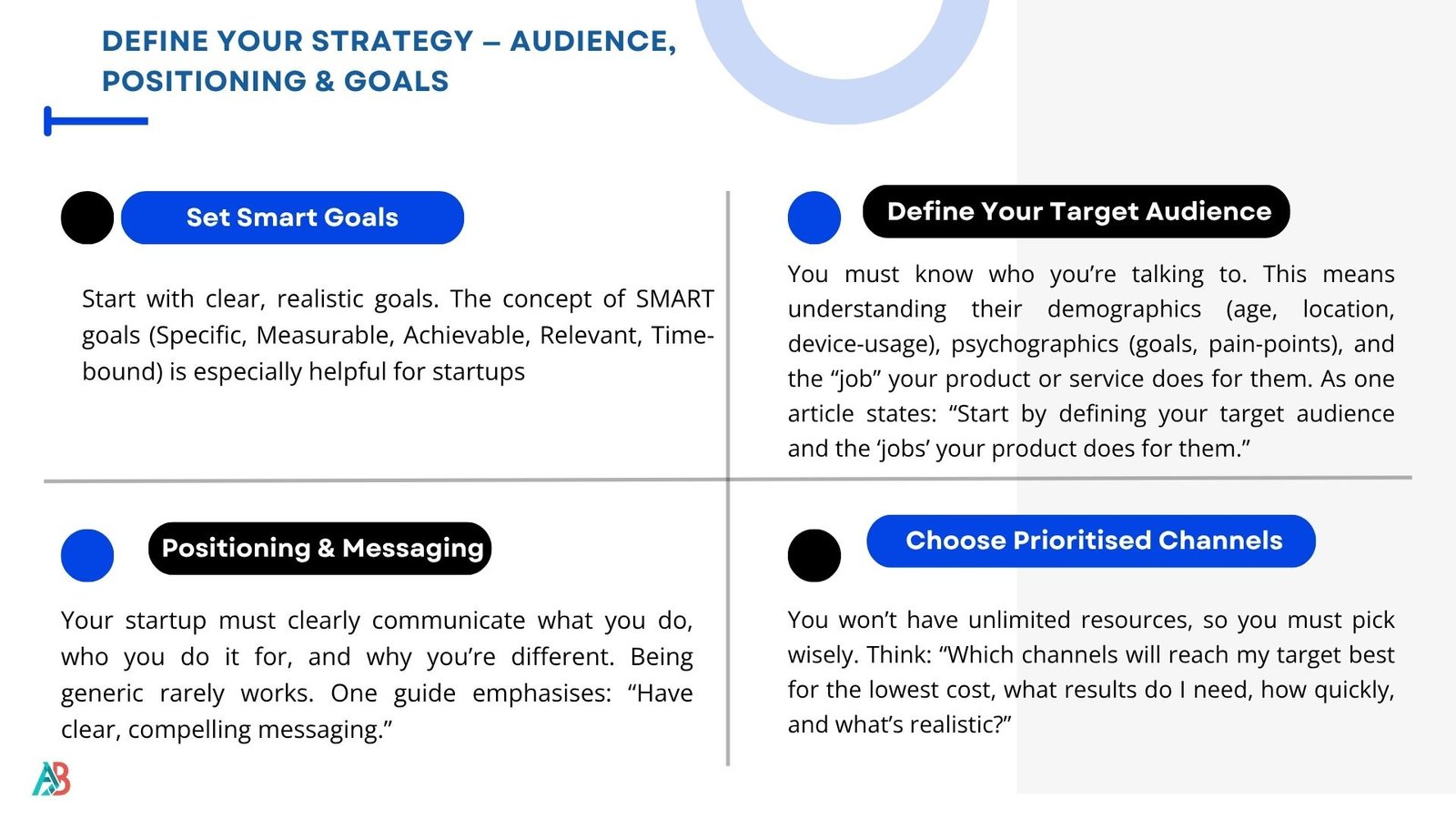
1.1 Set Smart Goals
Start with clear, realistic goals. The concept of SMART goals (Specific, Measurable, Achievable, Relevant, Time-bound) is especially helpful for startups. HubSpot Blog+1
Examples:
- “Increase organic website traffic by 30% in the next 3 months.”
- “Acquire 100 paying customers via Facebook ads by end of quarter.”
- “Grow email subscriber list to 1,000 by next 6 weeks.”
1.2 Define Your Target Audience
You must know who you’re talking to. This means understanding their demographics (age, location, device-usage), psychographics (goals, pain-points), and the “job” your product or service does for them. As one article states: “Start by defining your target audience and the ‘jobs’ your product does for them.” Helpware+1
When you’re clear on your target, everything else — messaging, channel selection, content — becomes far easier.
1.3 Positioning & Messaging
Your startup must clearly communicate what you do, who you do it for, and why you’re different. Being generic rarely works. One guide emphasises: “Have clear, compelling messaging.” HubSpot Blog
Define your Unique Selling Proposition (USP), your brand voice, and the key benefits you offer.
1.4 Choose Prioritised Channels
You won’t have unlimited resources, so you must pick wisely. Think: “Which channels will reach my target best for the lowest cost, what results do I need, how quickly, and what’s realistic?”
For startups, many sources highlight the core channels: website/owned media, content, social media, email, paid ads. Mailchimp+2reliablesoft.net+2
Rather than “doing everything”, pick 1-2 key channels initially, execute well, measure, then expand.
Build the Foundation — Website, Brand & Content
2.1 Website & Brand Presence
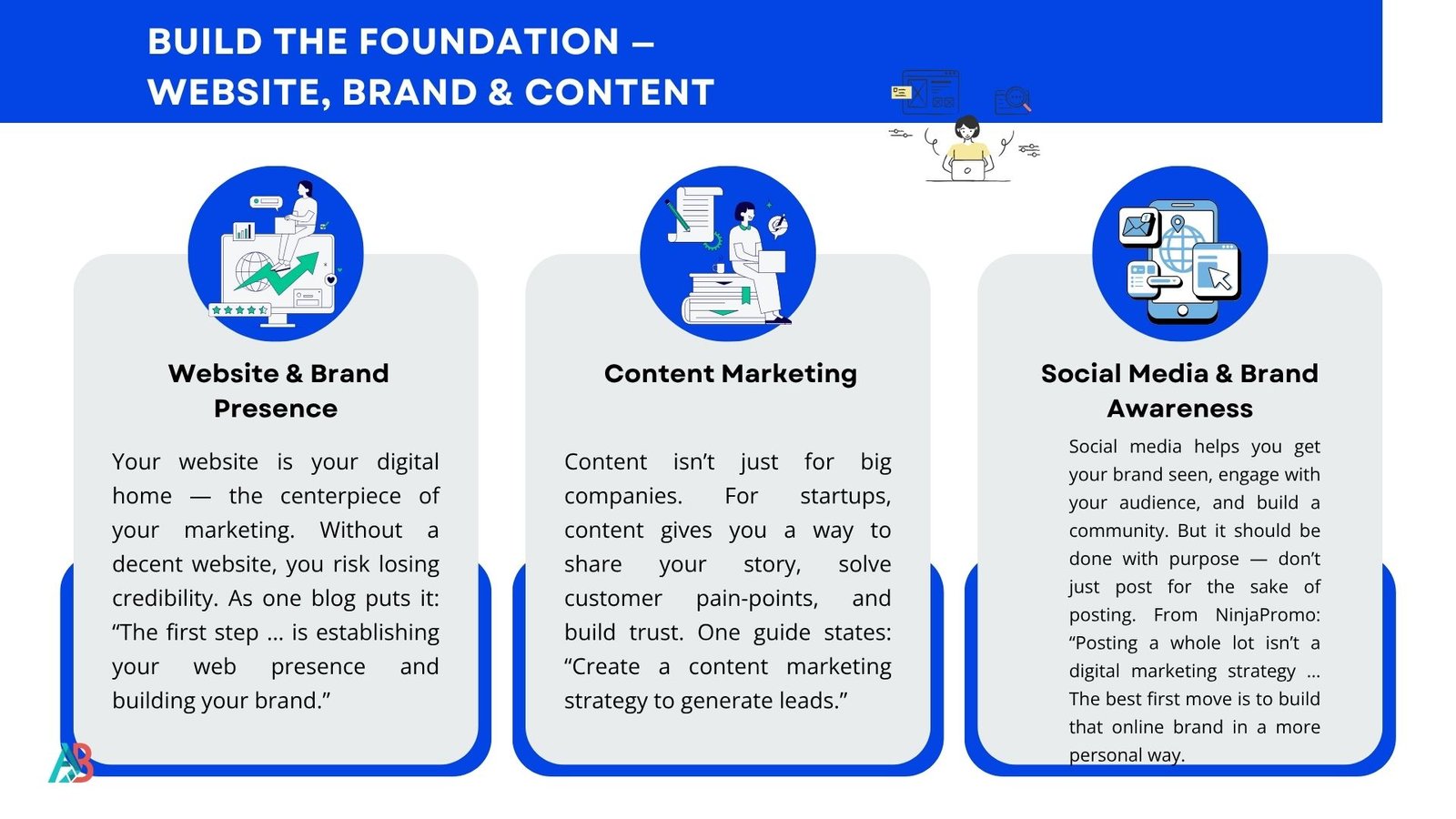
Your website is your digital home — the centerpiece of your marketing. Without a decent website, you risk losing credibility. “The first step… is establishing your web presence and building your brand,” according to one blog. dependableSoft.net Key considerations:
- Clean, professional design.
- Mobile friendly. Many users will come via smartphone.
- Clear value proposition on the homepage.
- Strong branding: logo, colours, tone.
- Good site structure and navigation.
2.2 Content Marketing
Content isn’t just for big companies. For startups, content gives you a way to share your story, solve customer pain-points, and build trust. One guide states: “Create a content marketing strategy to generate leads.” HubSpot Blog+1
Content types you could use: blogs, videos, infographics, case studies, FAQs. Focus on value for your audience, not just self-promotion.
2.3 Social Media & Brand Awareness
Social media helps you get your brand seen, engage with your audience, and build a community. But it should be done with purpose — don’t just post for the sake of posting. From NinjaPromo: “Posting a whole lot isn’t a digital marketing strategy … The best first move is to build that online brand in a more personal way.” Ninjapromo
Choose platforms where your target audience hangs out, and craft content accordingly.
Acquire Customers — Growth Channels for Startups
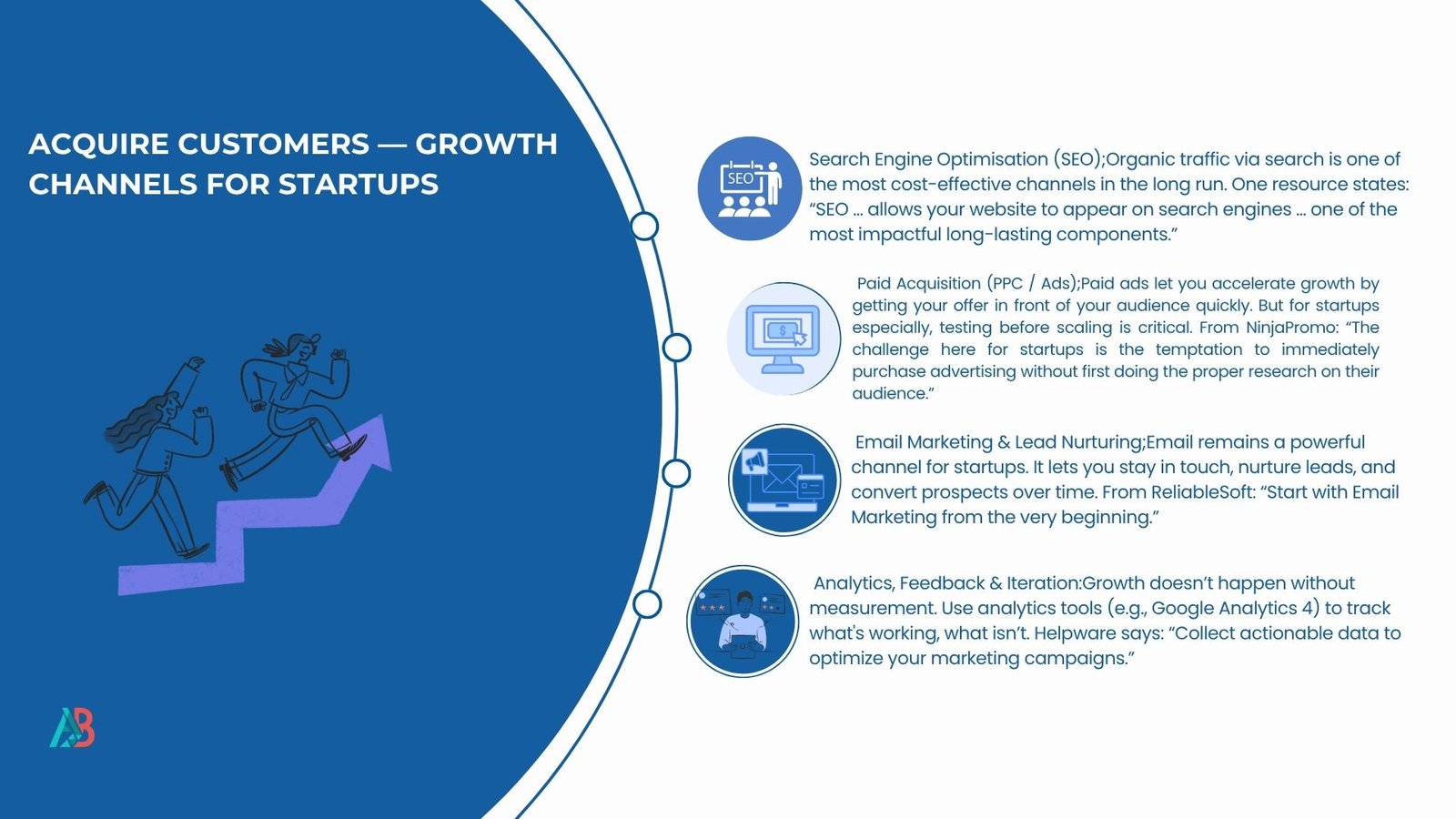
3.1 Search Engine Optimisation (SEO)
Organic traffic via search is one of the most cost-effective channels in the long run. One resource states: “SEO … allows your website to appear on search engines … one of the most impactful long-lasting components.” webtekcc.com+1
Key SEO steps for startups:
- Keyword research: find what your audience is searching for.
- On-page optimisation: titles, meta descriptions, headings, URLs.
- Technical SEO: site speed, mobile-friendly, structured data.
- Content strategy: create helpful content aligned with search intent.
- Link building & brand mentions: build credibility and authority.
- Local SEO (if relevant): for regionally-focused startups, optimise for local search.
3.2 Paid Acquisition (PPC / Ads)
Paid ads let you accelerate growth by getting your offer in front of your audience quickly. But for startups especially, testing before scaling is critical. From NinjaPromo: “The challenge here for startups is the temptation to immediately purchase advertising without first doing the proper research on their audience.” Ninjapromo
Best practices:
- Start small: test ad creatives, audiences, channels.
- Measure Cost Per Acquisition (CPA), Lifetime Value (LTV).
- Optimise before scaling budget.
- Consider retargeting (people who visited your site but didn’t convert).
3.3 Email Marketing & Lead Nurturing
Email remains a powerful channel for startups. It lets you stay in touch, nurture leads, and convert prospects over time. From ReliableSoft: “Start with Email Marketing from the very beginning.” reliablesoft.net
Tips:
- Build your subscriber list from day one (via website, content offers).
- Segment your audience: new leads vs existing customers.
- Automate drip campaigns: welcome series, product updates, re-engagement.
- Personalise and provide value, not just promotion.
3.4 Analytics, Feedback & Iteration
Growth doesn’t happen without measurement. Use analytics tools (e.g., Google Analytics 4) to track what’s working, what isn’t. Helpware says: “Collect actionable data to optimize your marketing campaigns.” Helpware
Key metrics for startups:
- Website traffic & sources
- Conversion rate (visitor to lead, lead to customer)
- Customer acquisition cost (CAC)
- Customer lifetime value (CLV)
- Churn rate (if applicable)
- Engagement metrics (email opens, social interactions)
Regularly review data, iterate campaigns, kill what’s not working, double-down on what is.
Growth & Scaling
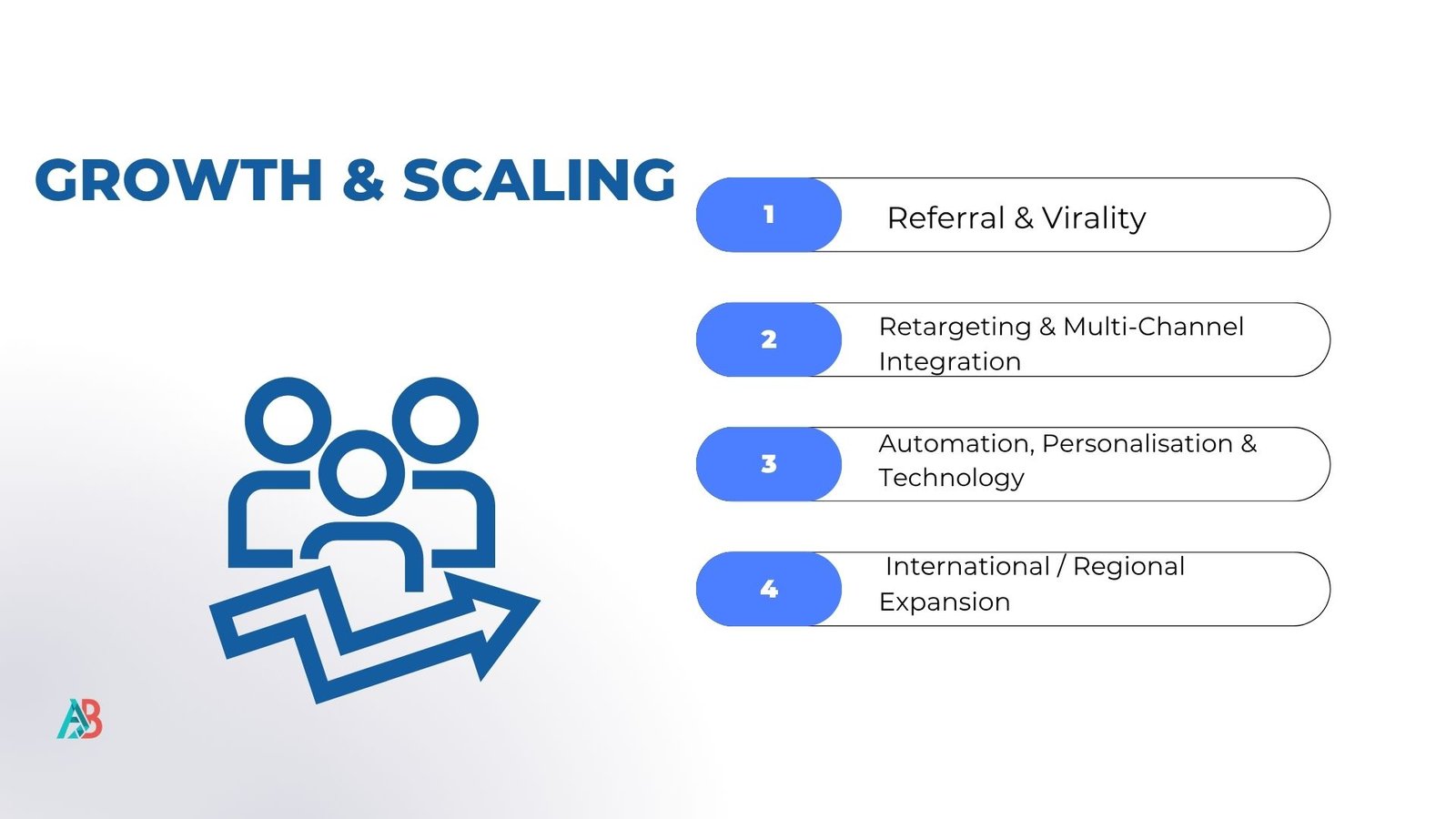
Once the basics are working, you can shift attention to growth and scaling your efforts.
4.1 Referral & Virality
Startups often benefit from word‐of‐mouth and referral strategies. According to HubSpot: building a referral engine is one of the “non-negotiables”. HubSpot Blog
Consider:
- Incentivising referrals (e.g., give discount for referring a friend).
- Encouraging user-generated content and reviews.
- Making your product easy to share.
4.2 Retargeting & Multi-Channel Integration
As you scale, you’ll want to retarget users who showed interest but didn’t convert. Also integrate channels so the user experience is seamless across touchpoints. Stripe
Think: someone sees you on social media, visits your website, receives an email, then sees an ad — consistent messaging across each.
4.3 Automation, Personalisation & Technology
As your user base grows, automation helps you stay efficient. From NL.edu: “Digital marketing offers technology to automate processes, personalise interactions, and coordinate actions so brands can grow faster.” nl.edu
Actions to take:
- Use marketing automation platforms for email, social posting, ads.
- Personalise messaging based on user behaviour (visited pages, clicked links).
- Use dynamic content (in emails or ads) to reflect user segments.
4.4 International / Regional Expansion
If your startup has a global or multi-regional target, digital marketing lets you scale across geographies. Helpware emphasises: you can “Reach a global audience, targeting people who want your product, regardless of their geographical location.” Helpware
But remember localisation: language, culture, payment methods, time zones matter.
Budgeting, Prioritisation & Common Mistakes
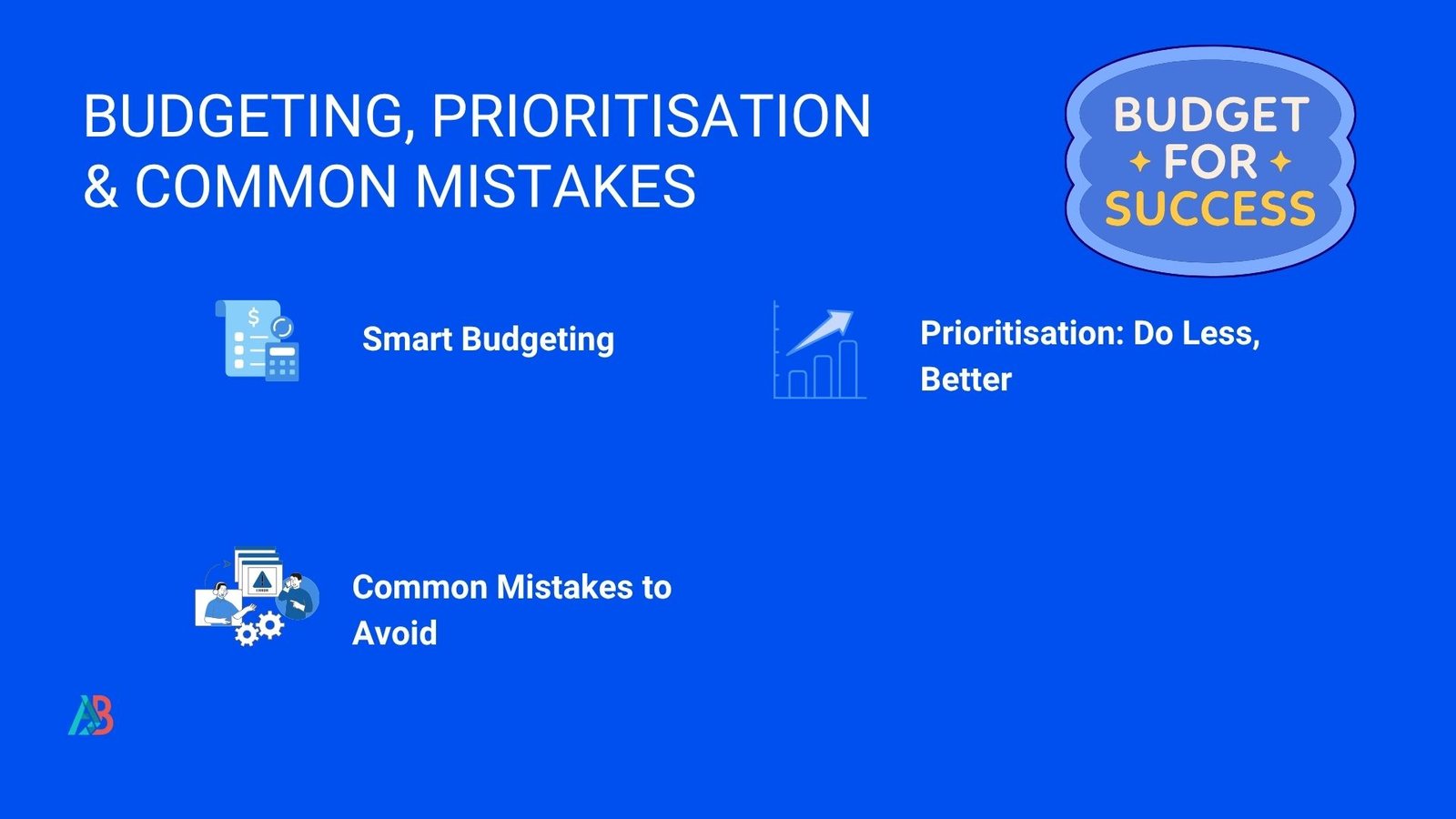
5.1 Smart Budgeting
Startups must allocate budget wisely. Some tips:
- Allocate more to channels you can track and scale.
- Keep a reserve for testing new channels.
- Don’t spend all on paid ads without formulating organic infrastructure (website, content, email).
- Measure ROI regularly and reallocate if necessary.
5.2 Prioritisation: Do Less, Better
Rather than spreading thin across dozens of tactics, focus on a few with high potential. HubSpot emphasises this in their “non-negotiables” list. HubSpot Blog
For example: if you find your target audience is active on Instagram and Google search, start there instead of being present on 10 platforms with inconsistent effort.
5.3 Common Mistakes to Avoid
- Launching paid ads before your website and brand are solid.
- Not defining your target audience clearly — the message becomes fuzzy.
- Ignoring measurement and blindly spending.
- Failing to iterate: what worked today may not work tomorrow; keep optimising.
- Trying to be everything to everyone — focus wins.
- Under-investing in content and infrastructure (SEO, email) and expecting instant paid success.
Sample 12-Month Roadmap for a Startup
| Month | Focus | Key Activities |
| Month 1 | Foundation | Build website, define brand, set SMART goals, create buyer personas. |
| Month 2 | Owned Media | Develop content calendar (blog + social), launch email list capture. |
| Month 3 | Organic Reach | SEO initial work, publish helpful blog posts, social media posts. |
| Month 4 | Test Paid | Run small budget Google or social ads to test messaging & audience. |
| Month 5 | Iterate & Optimize | Review analytics: which channels bring traffic, leads? Double-down. |
| Month 6 | Email Automation | Set up welcome series, nurture series, segment list. |
| Month 7 | Referral & Social Proof | Launch referral program, collect reviews & testimonials. |
| Month 8 | Broaden Channels | Consider retargeting ads, expand content (video, webinars). |
| Month 9 | Scale Paid | Increase budget on best performing ads, refine creatives and targeting. |
| Month 10 | Personalisation & Automation | Use dynamic ads/emails, advanced segmentation. |
| Month 11 | Expansion/Geography | Explore new regional markets or new audiences. |
| Month 12 | Review & Plan | Evaluate year’s metrics: CAC, LTV, churn. Plan Year 2 with insights. |
Here’s a sample calendar for year one of digital marketing for a startup:
Why It Works (and Why Some Startups Fail at It)
Why It Works
- Digital marketing offers measurable, scalable growth for modest budgets.
- The ability to test, learn, and iteratively improve means you’re not stuck with a failing strategy.
- You can build a brand, acquire customers, and create momentum even before huge budgets.
- For example, one source says: “Having a social media presence can boost a startup’s growth 10 times faster — and with a smaller marketing budget.” Forbes
Why Some Fail
- They don’t start with a strategy: no goals, no defined audience, no positioning.
- They spread themselves too thin across channels and never excel anywhere.
- They fail to measure and iterate, so budgets get wasted on underperforming channels.
- They expect instant results from SEO or content, without patience or infrastructure.
- They ignore their brand presentation (e.g., website, messaging) and thus don’t build trust.
Key Takeaways for Startup Founders
- Think of digital marketing early — ideally even before product launch or as part of it.
- Define your audience, your positioning, and your goals first.
- Build a strong foundation: brand identity, website, content strategy.
- Choose 1-2 channels to focus on initially — execute them well.
- Measure everything. Be ready to pivot and optimise fast.
- Use a mix of organic (SEO, content, email) and paid (ads) channels.
- Don’t neglect email marketing — it is one of the highest ROI channels.
- Think for the long term: build infrastructure that scales, not just quick wins.
- Budget smartly and prioritise what drives outcomes.
- And finally: growth comes from consistent execution, not sporadic bursts.
Final Word
For a startup, digital marketing isn’t optional — it’s central. It’s the engine that will power your awareness, your acquisition, and your growth. With clarity of audience, smart choices of channels, solid measurement, and consistent execution, even a modestly funded startup can punch above its weight.